
Taking the LEAP: A Leadership Journey Inspired by Kierkegaard

A few months ago, I was tasked with delivering a presentation to a group of new school leaders. My goal was to share valuable advice that could guide them as they embarked on their new roles. Drawing from both research on successful leadership and my own twenty-plus years of experience in school leadership, I identified four essential elements: Listening, Equilibrium, Authenticity, and Purpose. Broken down they can be summarized this way:
Listen before you speak
Find your equilibrium - that balance between your comfort and discomfort zones and be willing to delve into each
Being your true self
Focusing on purpose over problems
In the upcoming weeks, I will delve into each of these four elements of leadership, sharing insights from researchers and my own experiences, including the mistakes I've made and the lessons learned.
As I outlined my presentation, I arranged these four words in a Scrabble-esque manner, spelling out the word "LEAP" from the first letter of each piece of leadership advice. This brought me back to my college days and Philosophy 101, where the writings of the 19th Century Danish existential philosopher Soren Kierkegaard caught my attention with his concept of "a leap of faith." As a somewhat curmudgeonly fellow, Kierkegaard took many leaps. He questioned everything. He challenged conventional wisdom. He saw the world through the lens of both faith and reason and sought deeper meaning to the human experience that challenged his own comfort zone. He was willing to take leaps.
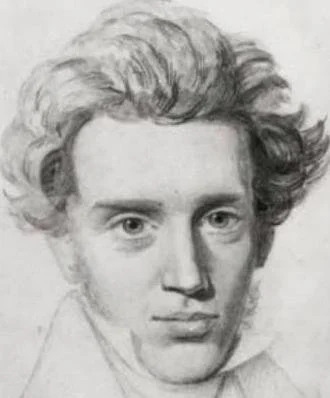
The phrase “a leap of faith” is attributed to Kierkegaard although scholars and historians debate whether or not he actually used the phrase. But his writing certainly reflected the notion that in each phase of our lives, we get to the next level of understanding and deeper meaning by taking a leap into the unknown; not completely void of reason and rationality but with plenty of ambiguity. Each leap requires courage and a reach into our discomfort zone but in the end, a sense of deep satisfaction and purpose that takes the form of “a special power to illuminate life” (from Stages of Life’s Way, 1845).
Reflecting on Kierkegaard's work and its relevance to new school leaders, the image of Leadership as a Leap of Faith started to form in my mind. While Kierkegaard wasn't necessarily writing with leadership in mind, his thought process resonates with lessons in leadership some two centuries later.
In his 1845 work, Stages of Life’s Way, Kierkegaard describes three stages of the human experience.. It begins with the aesthetic stage where we explore, have fun, and find things that interest us. The second phase is the ethical stage phase where we start to get serious - about life, our work and who we are. Here, we start to discover our commitments and develop the compass that guides us. The third stage is the transcendent stage where we find the ultimate purpose in our life, our work and our existence. We move from doing good to finding its ultimate source, driven by the “special power to illuminate our way.” It’s not just a compass; It’s our North Star. It lies deep within us, always there, always present, ever guiding.
Each of life’s phases requires a leap to reach the next level. This leap requires courage. It requires us to live with ambiguity, not fully knowing what the next phase will bring. However, each leap becomes easier as we grow more confident that we’ll land and find our way in the next phase. “The leap becomes easier”, says Keirkegaard, “the degree to which some distance intervenes between the initial position and the place where the leap occurs.”
I invite you to join me in the coming weeks as we further explore this notion of “leadership as a leap of faith.” Where we land, I’m not sure. But I’m confident it will lead us to a place, the light of which will help illuminate our way.
Edward B. Hollinger
January, 2024